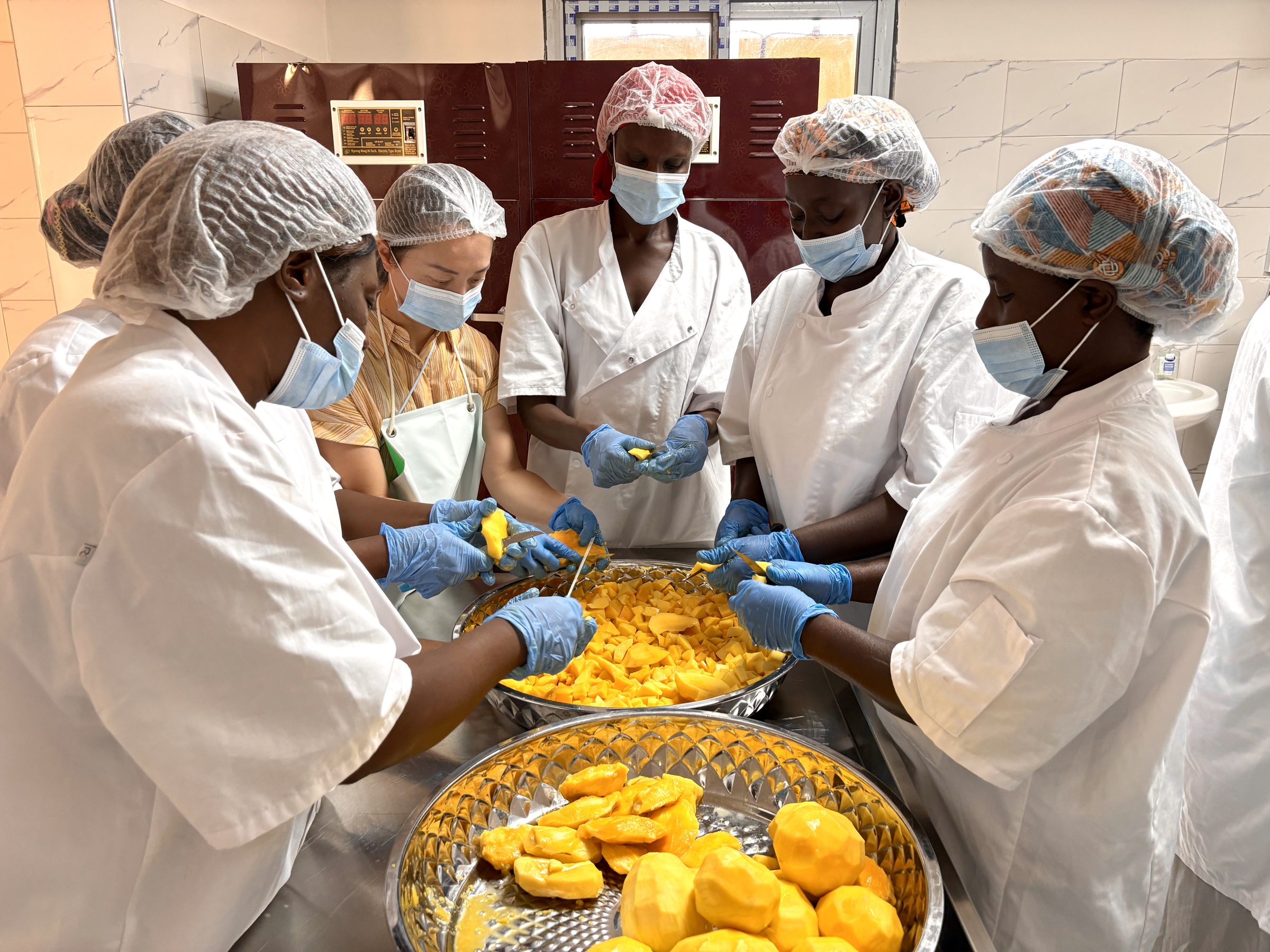
In Senegal, an estimated 50,000 tonnes of mangoes are lost every year. The harvest is concentrated from May to August and the fruit ripens all at once. With nowhere to keep it cold or to process it, prices collapse at the markets and unsold fruit rots under the trees.
SUCRECUBE Japon has built a chain to process this fruit into purée, freeze it and deliver it to Japan and France. For Africa to develop, it needs exports that bring in foreign currency. This is our second path: adding value locally and exporting.
A women’s group runs the processing
Processing is carried out by the women’s group GIE DIAMI SANDIARA in Sandiara. The group carries out the day-to-day production and quality control. SUCRECUBE Japon provides the equipment and the hygiene methods. The company works with the group under a pilot programme of Japan’s Ministry of Agriculture, Forestry and Fisheries. The processing steps were set with guidance from Okipota (Royal Entertainment Co., Ltd.), a mango dessert shop in Okinawa.
Training starts with practice and continues with theory, because fresh fruit is available only in season. At each step, the temperature, the time and the operator are recorded. The decision to ship is made on those records. The quality that Japanese and European buyers expect is proven on paper.
The cold comes from the sun
The purée is kept frozen at Site B, the solar cold storage site in Sandiara. The site runs 24 hours a day on solar panels and batteries alone. Even where there is no grid, the cold chain holds from harvest to export.
Where we stand
The products are being promoted in Japan and France under the name TUMIQUI Délice. In Japan, the first samples have been shipped to food companies. Desserts made with the purée are being developed with Okipota. The target markets are Japan and Europe. Compliance with each country’s food safety requirements is being checked step by step.
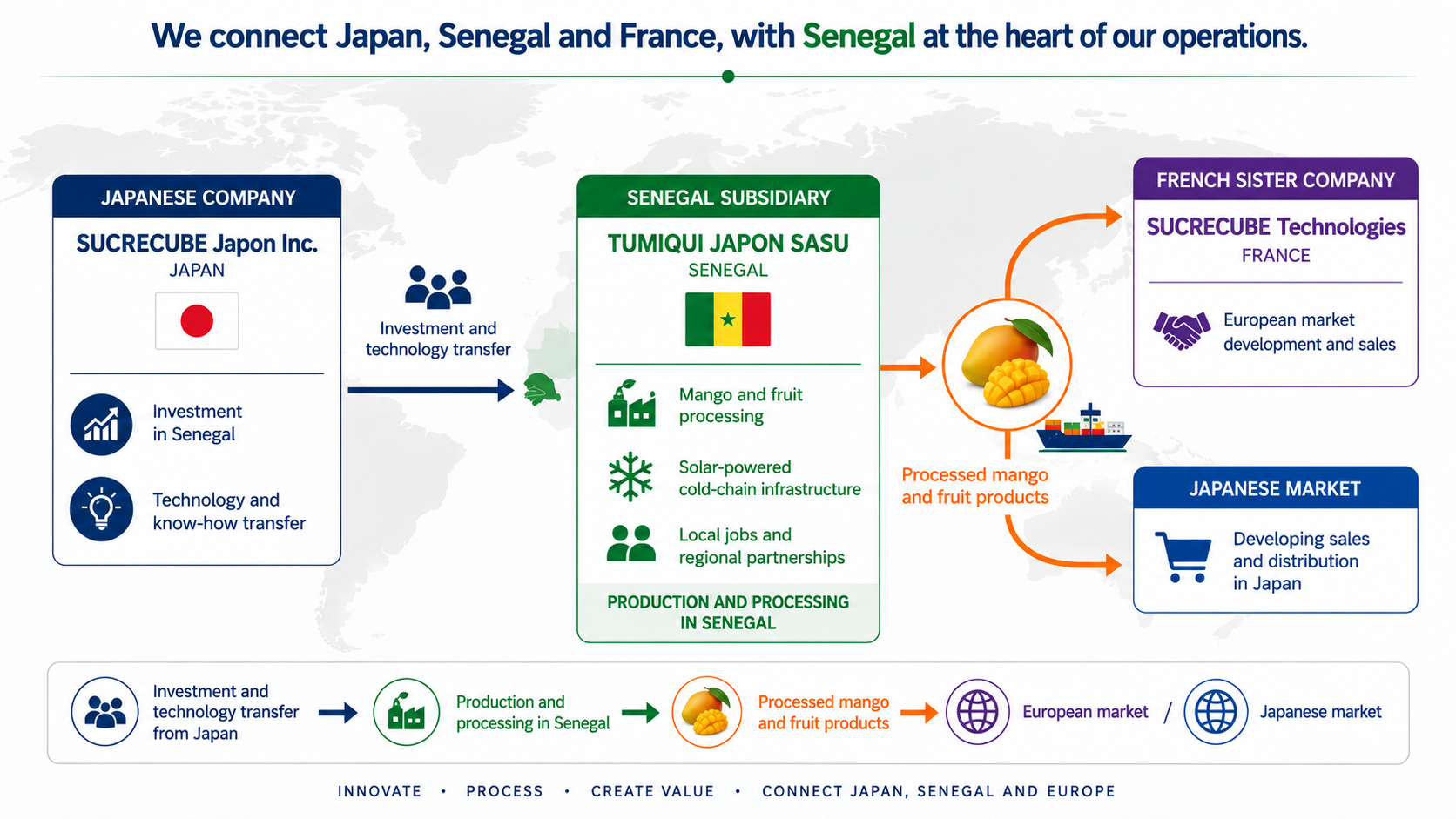
The Japanese company provides investment and technology transfer. The Senegalese subsidiary carries out production and processing with the women’s group, and the sister company in France develops the European market and handles sales. The role of each company is explained on the Mango processing and export page.
Why this path
Bringing a good product is not enough to keep a business alive in Africa. A business stands on its own feet when what is made locally sells for foreign currency. SUCRECUBE Japon put electricity and cold storage in the village, transferred processing skills to a women’s group and opened outlets in Japan and France. Mango is the first product.